Allah (c.c) şöyle buyuruyor:
Hayır işlerinde yarışınız!…” (Bakara, 148)
Onlar hayırda birbirleriyle yarışırlar…”(Âl-i İmrân, 114)
Bizler bir olmak için yarışıyoruz.
Anne ve babanın devamlı olarak kendini dikkatle takip etmesi gereken şey, davranışının nefsinden gelip gelmediğidir. Bütün mesele nefsi yarıştırmak değil, nefsi ıslah etmektir. “Ben” demeyi bırakıp “BİZ” demeye başladığımız noktada aile de toplum da gerçek anlamda birliğe kavuşur. Bir yolcunun deyişiyle: “nefsini yarıştıranlar başkalarıyla yarışıyor, nefsini ıslah edenler birbirine sarılıyor.”
What does it mean to "compete with the ego" then? In a family, the constant phrases of "I AM RIGHT," "I WANT MY WAY," "I KNOW BETTER" are the language of the ego. As parents, when we argue with our child, saying "I am your father/mother, you will not disobey me," we are actually competing with our ego. In the name of establishing authority, we damage the relationship. Or when we say, "You have no playtime for two days because you didn't listen to me," we are constantly emphasizing something. We are emphasizing something that children cannot see. I will skip over this emphasized point. Instead, let's think first as parents. Let's first look at the reason for this behavior of the young person. Approaching it reactively: "Why do you always make the same mistake!! Didn't I tell you to focus on your studies!! But you are always in the same place!! You need to take responsibility and listen to your studies!! Or are you not listening!!"
All these sentences are the words of someone giving advice and lecturing. These kinds of conversations are also the type of sentences that we young people dislike the most. We might love this communication so much that we end up going to our rooms and spending time alone. Yes, you heard right. You might think that we young people enjoy hanging out alone in our bedrooms, but when we reach adulthood, we will suffer. Therefore, I will pay the price for not being able to escape this cycle you've trapped me in, once again, with my stance in the face of wrong decisions in the future. And as two, three, four pass, you will be able to look me in the face and laugh at a fading silhouette.
You just read the words of a young person. I know you felt sad seeing this perspective that a young person looks at, but that's how things work. As our reactive faces contort, the taste of that relationship becomes unbearable.
- As an alternative to reforming the ego: "In this situation, we can both see valid points. How are you feeling, tell me. I will explain my own concerns to you. Let's find a solution together." Perhaps being able to say this is the concrete form of transitioning from 'I' to 'we'.
Or
- Expressions like 'I'm sorry, I don't feel well, I'm unhappy' when describing feelings are clue expressions. When we say, 'I know you are unhappy and feeling down. I will help you,' we also indicate positive boundaries.
As we experience disconnects, our souls also grow cold. What covers us are not the visible, outward gifts; but the words, glances, and attentive listening that will carry us beyond the beyonds...
As parents, do we want to hear what we want to hear; or are we putting on glasses that will carry us forward, asking, 'What does this tell me? What does this explain to me? What do these events tell me about myself and about life?'
It is true that we are accustomed to hearing expectations today. Aren't we tired of hearing these old structures? Don't we realize that sentences like "If this happens, let's do that, if this is like this, let's do that" are making things more incomprehensible instead of helping with our problems?
Let's not forget that this world is full of beautiful young people and people. And let's approach this place we are looking at with a prayer. Let's approach so that with these glasses that change our perspective, we can look at the youth and embrace them with a greeting. Those young people, when we look at them, we should clothe our souls with hope by saying, "My God, give me a friend who is dearer to me than myself." With God's permission. As we listen to them, we will see the cries in their souls. We will learn from their enthusiastic inspirations. At this point, as we allow them to test us, our resilience increases, and their excitement doubles, giving courage form. In this regard, listening allows them to trust their essence. As you get to know them, you embrace their garments that will make their souls felt. Therefore, try to understand. And just listen. Let's look for ways to listen better.
One of the points to be careful about here is related to panic. Parents can often act in a state of panic. However, panic fuels the vein of fear (havf), leading to undesirable behaviors. Thus, while parents and young people are trying to escape a small trouble, they can throw their relationship into a bigger danger.
- When your 17-year-old daughter comes home, her eyes are red, and it's clear she's been crying. When you ask, "What happened?" she says, "My best friend betrayed me, I can't trust her anymore." The parent's first reaction might be: "Forget it, I never liked that girl anyway. You focus on your studies, friendships pass." However, this reaction trivializes the girl's emotional world and leaves her alone. She may not want to share similar problems with you from now on.
Instead of panicking, approaching your child by saying, "You seem very upset. How do you feel in this situation? If you want, tell me a little, I'm listening to you" provides much more support. This approach makes your child feel that you are there for them when they need you and that you truly see them.
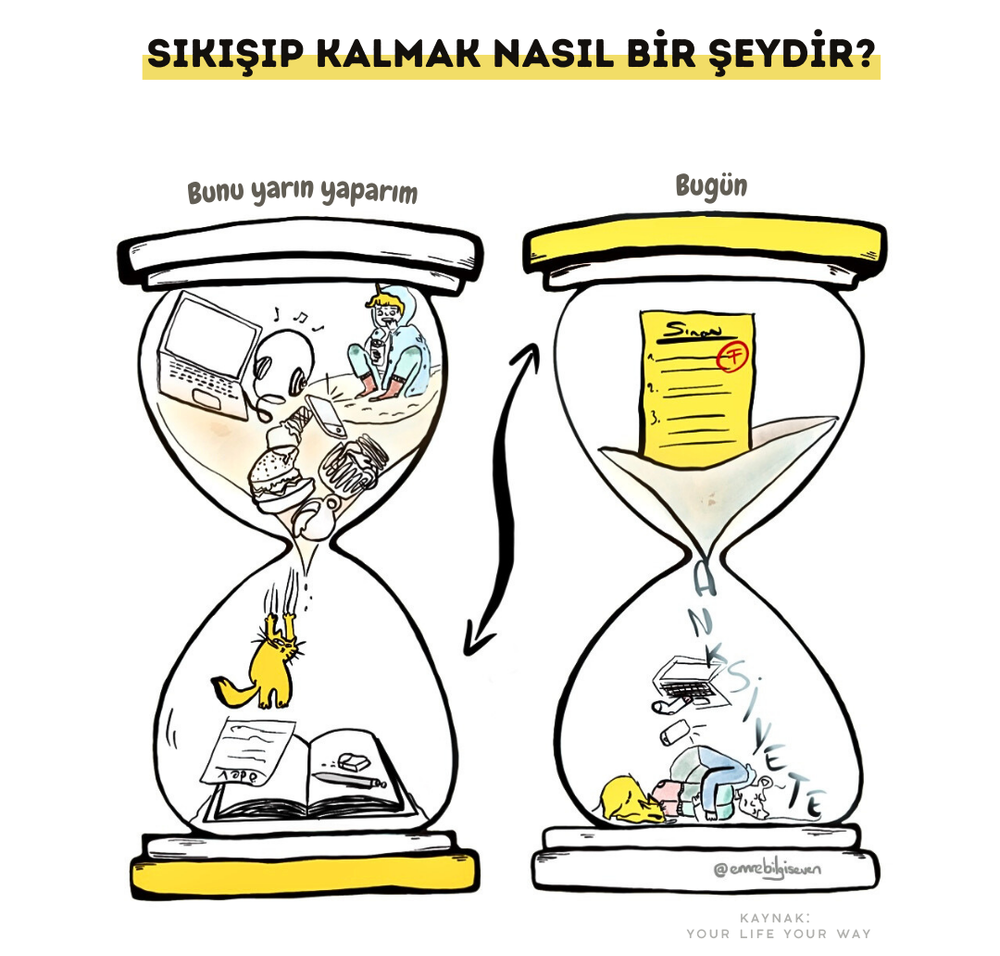
Otherwise, the child may withdraw to their room, put on headphones, and approach their family or parents with anger and insults. Over time, they may get caught in a musical vortex that entices them with addictive content, drags them into a bohemian atmosphere, and fuels their despair. They become trapped in a cycle with the frustration of not being able to do what they want in this vortex. Instead of setting their own time and exploring, they begin to experience the weight of a paradox where they are stuck in time. The hourglass metaphor you see below summarizes the situation.